1. The Real Numbers Behind Agricultural Drone Spraying Nobody Discusses
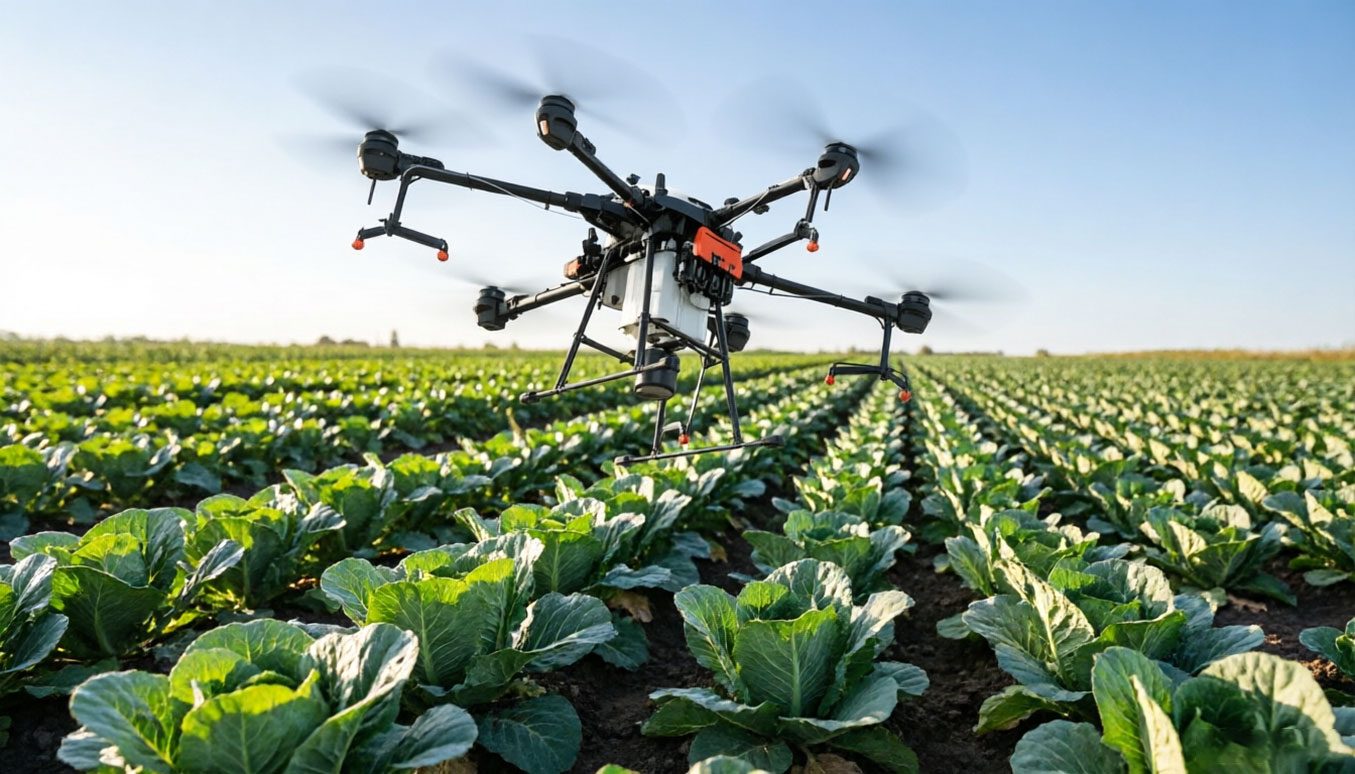
An agricultural drone's brochure says "30 hectares per hour." That number assumes a perfectly rectangular field, no obstacles, wind under 3 knots, tank refill in 90 seconds from a truck parked at the field edge, and a chemical mix with water-like viscosity. Real fields have power poles, irrigation equipment, irregular boundaries, wind gusts, and a refill crew working from a pickup bed half a kilometer away. The actual daily output — what matters when you're paying by the hectare — runs 40-60% of the brochure number.
This gap between brochure and reality isn't marketing deception. It's physics. And choosing an agricultural drone that actually delivers on your operation's economics requires understanding three numbers that decide everything: spray rate per mu, flight endurance per battery cycle, and maintenance cost per operating hour. Here is how to calculate each one for your specific operation — not the manufacturer's test field.
2. Spray Rate Per Mu: The Productivity Number That Matters
2.1 Tank Capacity vs. Actual Coverage
Tank capacity tells you how much liquid the drone carries. It does not tell you how many mu it covers per fill. That depends on your application rate:
- Conventional pesticide spraying: 0.7-1.5 liters per mu (10-22 L/ha). A 20-liter tank covers 13-28 mu per fill. A 40-liter tank covers 26-57 mu per fill.
- Herbicide application: 1.5-3.0 liters per mu (22-45 L/ha). Higher dilution ratio means less coverage per tank.
- Foliar fertilizer: 1.0-2.0 liters per mu (15-30 L/ha). Viscosity affects flow rate — thicker solutions reduce effective spray width.
The calculation is straightforward: Tank Volume (liters) ÷ Application Rate (liters/mu) = Coverage per Tank (mu). A DJI Agras T50 with a 40-liter tank, spraying pesticide at 1.0 L/mu, covers 40 mu per tank fill. At 1.5 L/mu, that drops to 26 mu. The difference — 14 mu per tank — adds up to roughly 4 additional refill cycles over a 200-mu day. Each refill cycle costs 2-3 minutes. That's 8-12 minutes of lost flight time per day, or roughly 15-20 mu worth of productivity.
2.2 Flow Rate Determines Spray Speed
Tank size gets the attention. Flow rate determines whether you actually use it. Centrifugal atomizer nozzles on systems like the DJI Agras series deliver 1-8 liters per minute per nozzle, with dual-nozzle configurations doubling the effective output. At 3 L/min total flow rate and a 6-meter spray swath, the drone covers approximately 1.8 mu per minute of spraying. At 8 L/min with the same swath, coverage jumps to roughly 4.8 mu per minute.
But higher flow rate means faster tank depletion. The 40-liter tank empties in 5 minutes at 8 L/min, versus 13 minutes at 3 L/min. The operational trade-off: high flow rate maximizes per-minute productivity but increases refill frequency and battery swaps. Low flow rate extends per-tank flight time but reduces daily output. The optimal setting depends on your field size and refill logistics — not the manufacturer's recommended default.
3. Flight Endurance: Battery Math Nobody Teaches
3.1 Empty Weight vs. Spray Weight
An agricultural drone's flight time splits into two distinct phases: transit (empty tank, returning to refill station) and spray (full tank, actively dispensing). The difference is significant because the aircraft's weight changes continuously during spraying. A DJI Agras T50 at maximum takeoff weight with a full 40-liter tank draws roughly 25-35% more current than the same aircraft returning empty.
Real-world battery endurance, accounting for spray-phase power draw:
- DJI Agras T50 (DB2000 intelligent battery, 20,000 mAh): Approximately 8-12 minutes per battery pair, depending on spray rate and wind. Two batteries per flight, hot-swappable.
- DJI Agras T25 (DB1560 battery, 15,000 mAh): Approximately 9-14 minutes per battery pair. The lighter airframe partially offsets the smaller battery capacity.
The critical planning number is battery cycles per day, not minutes per flight. At 10 minutes per flight and 90 seconds per battery swap, a single aircraft with 4 battery pairs can sustain roughly 6-7 flight hours per operational day. That requires 2 chargers running continuously (each battery pair charges in approximately 9-12 minutes on a D9000iP or equivalent fast charger). If your charger setup can't keep pace, you're paying for a drone that sits idle while batteries charge.
2.2 Generator vs. Grid Power for Charging
Field operations with zero grid access require a generator sized for simultaneous multi-battery charging. A D9000iP inverter generator (rated 9,000W peak) supports 2 battery chargers simultaneously, replenishing 4 batteries in roughly 12 minutes — matching the consumption rate of 2 batteries every 10 minutes. An undersized generator that can only run one charger at a time creates a battery bottleneck. The drone flies 10 minutes, then waits 12 minutes for batteries. That's 55% utilization — meaning you paid for a drone you can only use half the time.
4. Maintenance Cost Per Operating Hour: The Hidden Expense
4.1 Components That Wear and Their Replacement Intervals
Agricultural chemicals are corrosive. Water and pesticide residue attack every surface they touch. Components that require scheduled replacement:
- Centrifugal atomizer discs: 200-300 operating hours. Chemical residue buildup degrades atomization uniformity. Worn discs create uneven droplet sizes, reducing spray efficacy and increasing chemical cost per mu.
- Peristaltic pump tubing: 100-150 hours. Silicone tubing hardens and loses elasticity, reducing flow rate accuracy.
- Spray nozzles: 150-200 hours. Orifice wear increases flow rate beyond calibrated settings. An uncalibrated nozzle can dispense 10-15% more chemical than intended — wasted product that also risks crop damage.
- Propellers: 300-500 hours in agricultural environments (shorter than industrial inspection drones due to chemical exposure and dust).
- Motor bearings: 500-800 hours. Chemical ingress through shaft seals accelerates bearing degradation.
- Frame and tank seals: Inspect every 100 hours. Chemical permeation causes slow leaks that reduce spray accuracy.
4.2 Calculating Cost Per Operating Hour
A realistic maintenance budget for an agricultural drone operating 500 hours per year:
- Battery replacement: 4 pairs × $600 per pair ÷ 500 hours = $4.80/hour (batteries typically last 400-600 cycles before capacity drops below 80%)
- Atomizer discs: $30 per disc × 4 discs × 2 replacements/year ÷ 500 hours = $0.48/hour
- Pump tubing: $15 per set × 4 replacements/year ÷ 500 hours = $0.12/hour
- Nozzles: $25 per nozzle × 4 nozzles × 3 replacements/year ÷ 500 hours = $0.60/hour
- Propellers: $40 per set × 4 sets × 1.5 replacements/year ÷ 500 hours = $0.48/hour
- Motor rebuild/replacement: $200 per motor × 4 motors ÷ 600 hours = $1.33/hour
Total: approximately $7.80 per operating hour in consumable maintenance, excluding labor and fuel. That's roughly $3,900 per year for 500 operating hours — about 8-12% of the aircraft's purchase price annually. Operators who skip preventive maintenance end up paying significantly more in unplanned downtime and reduced spray accuracy.
5. DJI Agras Platform Comparison: Match the Machine to the Mission
DJI Agras T50: 50 kg MTOW, 40L spray tank or 50 kg spread tank. Dual centrifugal atomizers at 1-8 L/min each. DB2000 intelligent battery (20,000 mAh). Flying speed 3-10 m/s in spray mode. Best for: operations above 500 mu (33 hectares). The per-mu cost advantage over smaller platforms becomes meaningful above this acreage threshold because the tank capacity reduces refill cycles proportionally.
DJI Agras T25: 25 kg MTOW, 20L spray tank or 25 kg spread tank. Single operator portable — fits in a standard SUV without disassembly. DB1560 battery (15,000 mAh). Flying speed 3-10 m/s. Best for: operations under 500 mu, irregular field shapes, terraced terrain where the lighter airframe has maneuverability advantages, and service providers who move between multiple small farms daily.
DJI Agras T60: 62 kg MTOW, 50L spray tank or 60 kg spread tank. The largest capacity in the Agras lineup. Dual active phased array radars. Best for: large-scale row crop operations above 1,000 mu. The 50L tank covers roughly 63 mu per fill at 0.8 L/mu — meaning fewer refill cycles and higher daily throughput on contiguous fields.
6. Three Questions to Answer Before Buying
- What is your actual daily mu target? Not the brochure number — your real fields, your real refill logistics, your real weather windows. Calculate backward: Daily Target (mu) ÷ Coverage per Tank (mu) = Refill Cycles per Day. Refill Cycles × (Flight Time + Refill Time + Battery Swap Time) ÷ 60 = Operating Hours per Day. If the result exceeds 8 hours, you need a larger tank or faster refill logistics — or a second aircraft.
- What is your charger-to-battery ratio? One charger per two battery pairs is the minimum. If your generator can't support two chargers simultaneously, budget for the upgrade before buying the drone. The drone's productivity is gated by battery availability, not by its flight specs.
- Have you budgeted $8-12/hour for consumable maintenance? This is not optional. Agricultural chemical exposure degrades mechanical components on a predictable schedule. Delaying atomizer disc or nozzle replacement saves $30 this month and costs you $300 in wasted chemical and reduced crop yield next month.
7. Summary: Buy the Logistics, Not the Spec Sheet
An agricultural drone is a chemical delivery system with wings. The wings matter. The chemical delivery system — tank, pump, nozzles, flow control — matters more. A 40-liter tank that refills in 90 seconds from a well-positioned support vehicle will outperform a 50-liter tank that takes 4 minutes to refill from a distant truck every single time. The aircraft is the visible investment. The invisible investment — batteries, chargers, generator, refill station, spare atomizer discs — is what determines whether you actually hit your mu-per-day target.
Evaluating agricultural drone options for your specific crop and acreage? We provide payload and logistics configuration reviews matched to your operational scale. Contact our technical team with your daily mu target and field characteristics for a realistic throughput estimate.