
Remote-Area Drone Delivery Guide: Real Payload, Endurance and Use Cases
When dealers come to us about logistics projects, the first complaint is almost always the same: the customer's address is one dot on a map, surrounded by mountains, an island, or a stretch of trackless desert. Trucks can't get in, and the cost of the last few kilometres often exceeds the cost of the thousand before it. This guide lays out, in plain numbers from the actual machines we ship, what drones in remote areas can really deliver — what they can carry, how far, and for how long. No overpromising.
Machine specs at a glance (from products already published on the site — directly verifiable)
- TS100 Quad-Octocopter Cargo Drone: max payload 100 kg; nominal 30 km image-transmission/control range; endurance ≈ 50 min no-load, ≈ 10 min at full 100 kg payload; wind resistance level 6; ceiling 1500 m; 1080P stabilized gimbal camera.
- FY-VT04 Long-Endurance VTOL Drone: VTOL fixed-wing + multirotor; max payload 2.0 kg (best 1.5 kg at ≈ 140 min); no-load endurance ≈ 240 min; nominal 30 km ground-station range; cruise 68–94 km/h; wind resistance level 7, usable in moderate rain; ceiling 4800 m; composite airframe.
- DJI-ecosystem airdrop / sling kits (AD2 / PT2 / PT4 / PTS4 / ET4 / UT4A / PL10): built on DJI PSDK / E-Port, compatible with DJI industrial platforms, used for rescue supplies, first-aid kits, and AED precision drops.
1. Why Remote-Area Logistics Is a World-Class Problem
Get the pain on the table first, and it's clearer what drones actually plug into.
- Thin road network, scattered population. Settlements on islands, in mountains, or in desert often have one truck a day — or none at all. Per-parcel cost is blown up by distance and deadhead mileage.
- The last kilometre is the most expensive. Trunk-haul rates are reasonable; the final hand-off by foot or by small vehicle is where cost crosses fifty percent of the total.
- Post-disaster and island scenarios are extreme. After an earthquake, a flood, or a road closure, the ground channel simply stops. Conventional delivery cannot run.
- No visibility. For remote stations, you often can't tell whether stock is in, whether the road is passable, or whether terrain has changed. Head office is operating blind.
Drones can't solve the fantasy of "flying every parcel". But in the scenarios above, they turn "undeliverable" into "deliverable".
2. The Real Capability of Drone Delivery (Setting Expectations)
We do this with two machines that are actually in production, with very different roles. Don't mix them up.
TS100 — 100 kg-class bulk-load delivery.
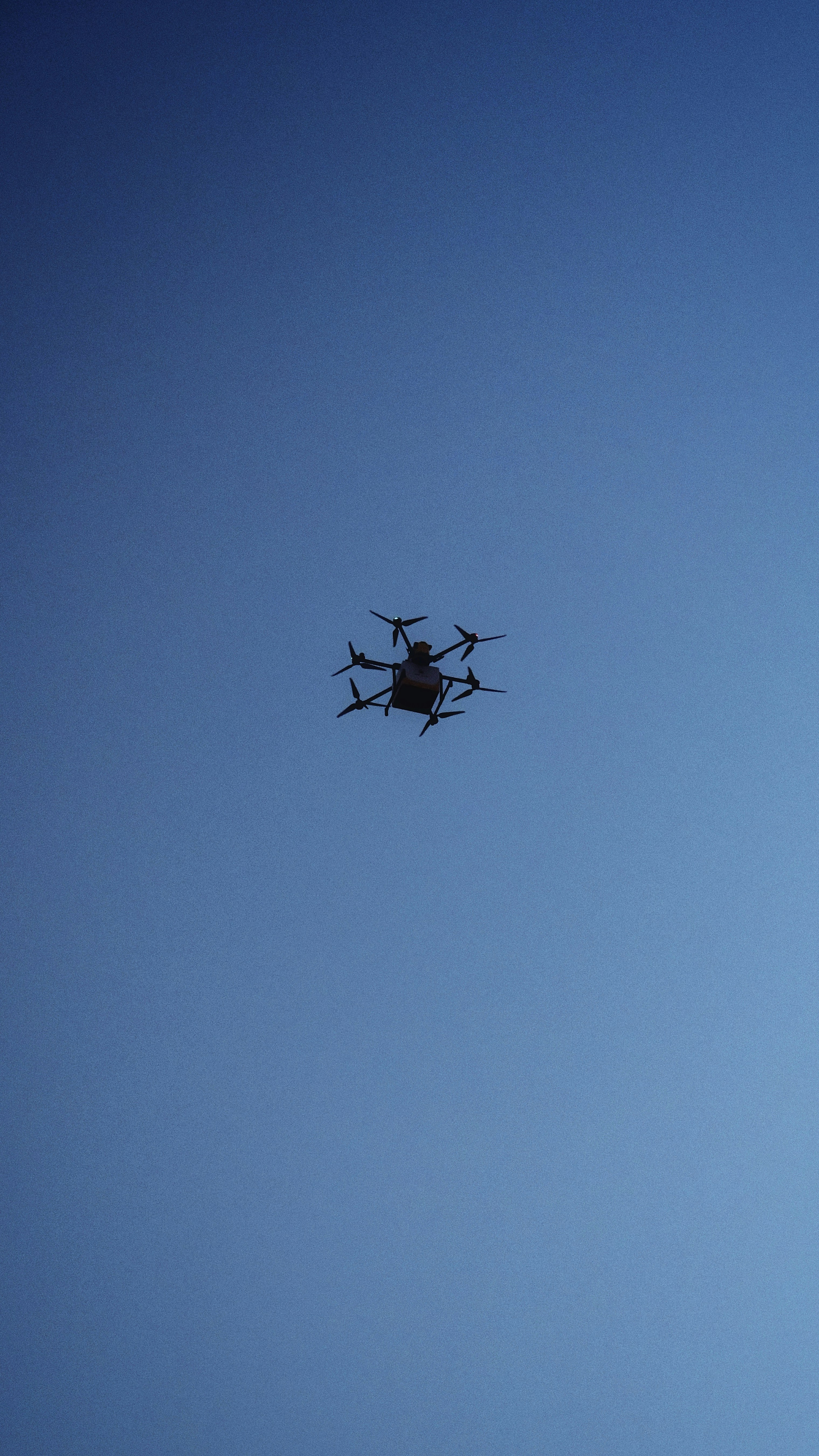
It's a quad-octocopter layout with eight motors, max payload 100 kg. It exists to move lots of material in a single lift — full boxes of food and medicine to island stations, construction materials to remote sites, bundled supplies to disaster zones. Nominal image-transmission/control range is 30 km, and it supports remote route planning, so an operator at base can lay in a fixed mission before launch.
One line has to be said up front: its endurance falls off a cliff as payload climbs. No-load, around 50 minutes. Hit 100 kg and you're down to about 10 minutes. TS100 is not a "long-endurance" machine. It is a "carry a lot, deliver close, deliver fast" machine. Using it as a long-range scout misreads what it is.
FY-VT04 — wide-area reconnaissance plus light package delivery plus disaster monitoring.
This one is a vertical-take-off-and-landing fixed wing. It takes off and lands like a multirotor and transitions to fixed-wing cruise. Max payload is only 2.0 kg (best at 1.5 kg for about 140 minutes; no-load about 240 minutes), so it isn't a heavy-lift platform — it is a "fly far, see a lot, carry something light on the way" platform. Real use cases are light package delivery, power-line inspection, terrain mapping, and disaster monitoring.
Both machines are for civilian use (material delivery, emergency response, island resupply, construction). Not for combat, not for weaponisation.
3. Typical Use Cases (Drawn From the Real Product Scenario Field, Not Invented)
What follows is taken directly from how the products are described on the site. Nothing added.
- Island and remote-station bulk resupply. TS100 lifts full boxes of food, medicine, and spare parts in one go — the product record explicitly lists "island resupply". It suits offshore islands with no scheduled boat service.
- Construction-site material transfer. Rebar, tools, small equipment, anything that would otherwise need a temporary haul road can go direct from the yard to the working face in 100 kg-class lifts.
- Disaster monitoring plus light package delivery. FY-VT04 flies out long-endurance, maps the affected area, marks the damage points, and carries small supplies to priority locations. The product record lists "disaster monitoring".
- Last-kilometre work in complex terrain. FY-VT04 does a recon pass to find road status, landslides, and water levels; TS100 then runs bulk drops to the points the recon identified. Recon and delivery play off each other and avoid blind drops.
- Precision drop of emergency supplies. First-aid kits, AEDs — anything that has to land in a precise spot — runs on the DJI-ecosystem airdrop/sling kits (AD2 / PT2 / PT4 / PL10, etc.). These kits are built on DJI PSDK / E-Port and are compatible with DJI industrial platforms. They are ecosystem accessories, not payloads of our own cargo drones. Which platform to fly them on depends on the DJI model the customer is using.
4. How to Choose Payload and Delivery Method
Don't start by asking "how much can it lift?" Start by deciding whether the job is "bulk large-item" or "small-item precision".
- Bulk large-item. TS100, 100 kg-class sling delivery. Suits station resupply, construction sites, bundled disaster supplies.
- Small-item precision. FY-VT04 (≤ 2 kg) paired with DJI airdrop kits for precision drop — but the kits are compatible with DJI industrial platforms as ecosystem accessories, so confirm the DJI model up front before quoting.
- Our own cargo platforms (TS100 / FY-VT04) don't carry DJI-compatible loudspeakers, spotlights, or similar accessories. Those payloads belong to the DJI ecosystem and shouldn't be mixed into our machine's payload list.
5. How to Fit Into Your Existing Logistics Network
Drones aren't there to replace trucks. They're there to cover the leg trucks can't reach. Common dealer rollouts look like this:
- Trunk-haul brings the load to the nearest consolidation point. The drone flies from the consolidation point to the end station or working face.
- For remote stations, the drone does regular inspection and inventory checks, and head office gets live imagery back. No more waiting for someone to file a report.
- After a disaster, FY-VT04 goes up first to map the corridor, and only then do trucks enter and TS100 drops begin.
In short, it's the extending arm of ground transport, not a separate system.
6. Deployment Essentials (Practical, Not Just the Spec Sheet)
If you're actually going to fly, these need to be planned in advance.
- Endurance tradeoff. TS100 at full payload is about 10 minutes. The drop point must be close to base, or there have to be waypoints. FY-VT04 in light configuration is long-endurance and suits wide-area recon.
- Image-transmission and control range. Both machines are nominal ≈ 30 km. That's the link range, not a one-way delivery range. Reserve margin for the return leg and terrain shadowing.
- Weather window. TS100 handles wind level 6, FY-VT04 handles wind level 7 and moderate rain. Thunderstorms, strong crosswinds, and dust still mean no-go. Check the window before launch.
- Take-off and landing area. TS100 with eight motors needs a flat pad. FY-VT04's vertical take-off is forgiving, but the fixed-wing segment needs clear airspace.
- Remote route planning. TS100 supports pre-set routes, which fits a fixed-frequency resupply line. The operator doesn't have to hand-fly every sortie.
7. Sourcing and Procurement Tips (Dealer View)
Three questions to ask the customer before recommending a machine: what are you carrying, how far, and how heavy?
- Carrying large, bulk, short-range loads: TS100 100 kg-class is the workhorse.
- Carrying light loads, over a wide area, while watching the ground: FY-VT04 fits.
- Carrying first-aid kits / AEDs that need to land precisely: pair a DJI airdrop kit with the appropriate DJI platform.
If the customer wants strong branding, our earlier Drone OEM/ODM Customization Guide for Exporters walks through how to customize appearance, payload, and flight-control parameters for the target market. The same approach applies to logistics machines. For the Middle East and Africa context, our Middle East and Africa Drone Market Guide has the section on remote-delivery demand.
8. Civilian Use and Compliance Boundaries
Saying this up front is better than arguing about it later.
- Everything here is civilian use — material delivery, emergency response, island resupply, construction. Not combat, not weaponisation.
- We do not promise overseas local repair or long-term on-site warranty. What we do provide is factory QC, technical documentation, spare-parts lists, and remote technical support. The local service network is the dealer's to build or to contract to a third party.
- Actual operation must comply with the aviation authority rules of the country where the machine is flown. Specific airworthiness, certification, and licensing details vary country by country and are not spelled out here — they must be checked item by item against the regulations of the target country before deployment.
9. Cost and Return Considerations (Limitations, Honestly)
Drones aren't a silver bullet. When the customer is running numbers, include these in the model.
- Short endurance at full load. TS100 at 100 kg is around 10 minutes. The lift is large but the sortie count is limited. It fits "few large lifts", not "high-frequency small parcels".
- Weather window. Bad weather, no flight. There must be a ground-plan fallback; don't make the drone the only channel.
- Payload ceiling. 100 kg-class solves a lot of station resupply, but full-truck-load transfer it can't do. Heavy infrastructure still needs ground.
- The return is mainly from "turning undeliverable into deliverable" and "saving the cost of new roads and deadhead miles", not from replacing trunk haul.
Put the math on those lines and the customer won't be surprised six months in.
10. FAQ
Can your drones actually sling and deliver cargo?
Yes, but the right machine depends on the job. TS100 carries up to 100 kg for bulk-load delivery — island resupply, construction transfers, bundled disaster supplies. FY-VT04 carries up to 2.0 kg for light package delivery plus wide-area recon. Both are civilian use. For first-aid kits, AEDs, and other precision drops, use the DJI-ecosystem airdrop kits and confirm the compatible DJI platform.
How far can they fly, and how long?
Both machines have a nominal image-transmission/control range of about 30 km. That's the link range, not a one-way delivery range. TS100 is around 50 min no-load and around 10 min at full 100 kg payload. FY-VT04 is about 140 min at 1.5 kg and about 240 min no-load. Endurance changes a lot with payload — calculate against the real load, not the no-load spec.
Can they work in remote areas with no network?
Yes. TS100 supports remote route planning — the operator lays in the fixed mission at base and the drone flies it. The image-transmission and ground-station link runs on the machine's own RF chain, not public mobile data. Actual coverage depends on the local terrain and link margin.
What advantages does drone delivery have over traditional road transport?
Three main ones. No road needed to reach mountain, island, or desert sites. When the ground channel is broken by a disaster, drones can reopen resupply quickly. Real-time visibility on remote stations' stock and conditions — head office doesn't have to wait for someone to report. Drones are the leg trucks can't reach, not a replacement for trunk haul.
Which aircraft are the airdrop kits compatible with?
Our airdrop / sling kits (AD2 / PT2 / PT4 / PTS4 / ET4 / UT4A / PL10) are built on DJI PSDK / E-Port and are compatible with DJI industrial platforms. They are DJI-ecosystem accessories, not payloads of our own cargo drones (TS100 / FY-VT04). The specific DJI model to fly them on has to be confirmed before order.
How do we get started?
Tell us your scenario, what you want to carry and roughly how heavy, and your target market. We'll work up a model-matching recommendation against the real machine specs. If you need branding, OEM/ODM is the route. For the detailed next-step flow, get in touch and we'll go through it one on one.
Want to plug drone delivery into your existing logistics network? Contact us for a free model-matching assessment — tell us the scenario, the payload, and the drop point, and we'll lay out the plan against the real machine numbers.