Many buyers—especially DJI Enterprise users—react to spec sheets with the assumption that they must choose between flying far and carrying heavy payloads. However, in actual selection, these two variables are never antagonistic. They are jointly constrained by the energy density of the same battery, and the real divergence happens if you make a wrong turn before understanding your own operational scenarios.
## 1. Operation Radius vs. Payload: Why It's Not a Simple Either-Or
Energy conservation is the underlying constraint, but not the only variable. It is true that with a fixed battery capacity, increasing the payload inevitably reduces the flight range. However, lightweight fuselage designs and highly efficient power systems can significantly widen this balance zone. For example, a carbon-fiber platform like the DJI Matrice 350 RTK can still achieve a 50km operation radius with a 2.8kg dead weight, and this performance can be further extended with high-energy-density batteries.
More importantly, the type of mission dictates the priority:
- Topographic mapping requires high-precision positioning and long endurance; the payload is rarely the bottleneck.
- Firefighting primarily focuses on wind resistance and effective payload capacity; range limitations can be mitigated by multi-point deployment.
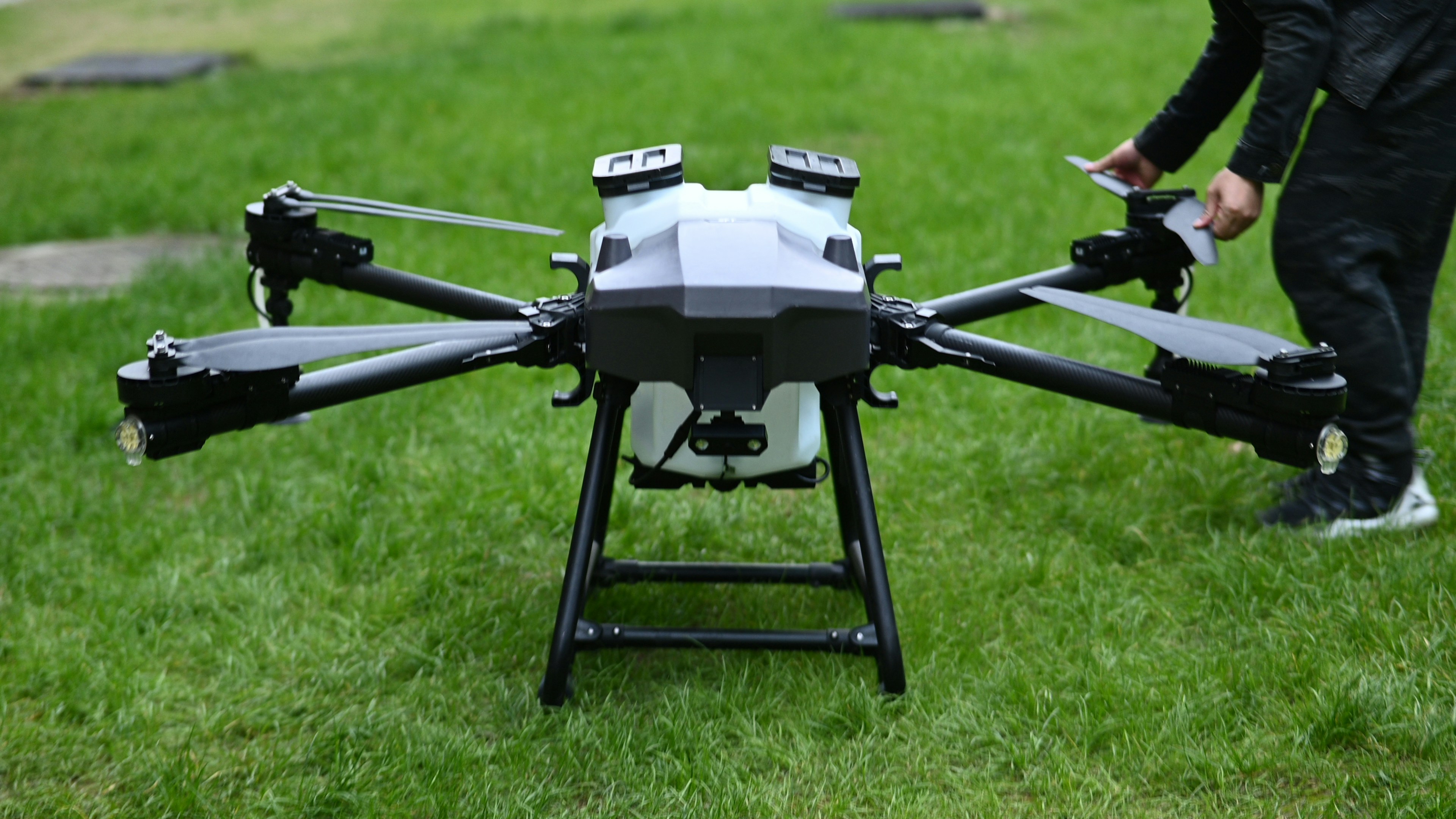
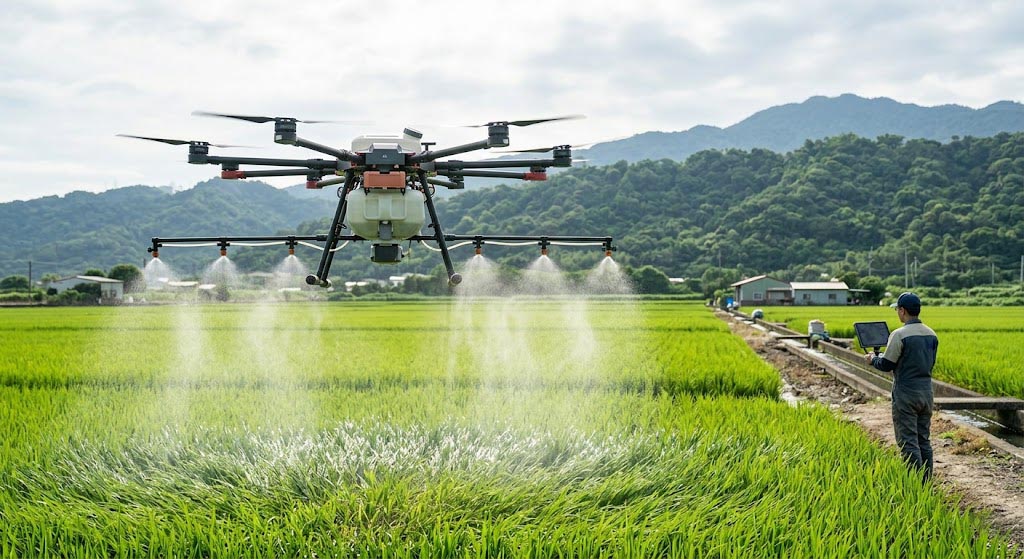
- For agricultural spraying drones, the core metric is the matching degree between the tank capacity and spray width; the trade-off logic between range and payload is entirely different.
There is also an easily overlooked hidden cost: pursuing maximum range might sacrifice maintenance convenience. For a specific model claiming operation at a 4,000-meter altitude, you might need to frequently replace the propellers when flying above 3,000 meters. This information isn't on the spec sheet but will directly consume your operational time window.
Figure out exactly what your mission requires, then work backward to determine the right combination of range and payload—not the other way around.
## 2. Flight Time and Range: Three Conversion Traps the Spec Sheet Won't Tell You
The "maximum flight range" listed by manufacturers is typically based on a windless environment and uniform linear flight—these are lab numbers, not field data. In actual operations, there are at least three layers of reduction:
1. Meteorological Compensation: Under Level 5 wind conditions, energy consumption increases by more than 30%; at high altitudes, lower air density causes a proportional drop in motor efficiency.
2. Payload Consumes Flight Time: Mounting a surveying gimbal or a thermal imager can reduce hover time by 40% compared to an unloaded state.
3. Mandatory Redundancy: Ground station systems mandate keeping a 20% battery reserve for emergency return-to-home, and you cannot touch this portion of the endurance.
Scenario Conversion References:
- A surveying drone with a nominal 50km range will only have about 35km of actual usable range once it enters complex mountainous terrain.
- A firefighting drone with a nominal 30kg payload will see its effective operation radius drop to 60% of the nominal value after installing a water cannon module.
When selecting a model, apply these three reductions to your specific operational environment to calculate the true numbers.
## 3. Configuration Schemes for Four Operational Scenarios
### Scheme 1: Large-Scale Surveying
- Core Needs: Centimeter-level positioning accuracy, continuous coverage capability.
- Recommended Configuration: RTK positioning + mechanical shutter camera, six-directional obstacle sensing is a must. Taking the DJI Matrice 350 RTK as an example, its PSDK interface can mount third-party surveying payloads directly without an adapter board.
- Pitfall Avoidance: Beware of "basestation-free" marketing claims—in actual operations, third-party correction services remain a strict necessity.
### Scheme 2: Emergency Material Delivery
- Core Needs: Wind resistance + rapid deployment.
- Recommended Configuration: Carbon fiber body + dual-battery hot-swapping; modular design can significantly compress loading time.
- Special Considerations: Take-off and landing site requirements are much stricter than those for aerial photography drones. Scouting the site in advance is a hard requirement.
### Scheme 3: Linear Infrastructure Inspection
- Core Needs: AI recognition + harsh environment tolerance.
- Recommended Configuration: Infrared thermal imaging + millimeter-wave radar; ensure the IP protection rating meets the IP55 standard. The DJI Matrice 30/350 series natively supports H20N infrared payloads; if using third-party IR modules, verify that the PSDK power supply can meet the sensor's peak power consumption.
- Hidden Advantage: Some models support a 5m/s climb rate, which reduces the time lost from hovering layer-by-layer during high-voltage transmission tower inspections.
### Scheme 4: Precision Agriculture
- Core Needs: Uniformity of pesticide spraying.
- Recommended Configuration: Dual shock-absorbing gimbal + terrain following. The matching algorithm between spray width and flight speed is key to uniformity. The DJI Agras series delivers stable spray uniformity, but when mounting third-party agricultural payloads on non-Agras platforms, you must independently verify the communication protocol compatibility between the flow controller and the flight controller.
- Cost Trap: For a nominal 10L operational tank, after deducting pipeline residue and liquid tilt loss, the actual effective capacity might only be 8.5L.
## 4. The Drone Isn't the Bottleneck—The Charging Station Layout Is
The biggest hidden constraint of remote operations isn't the drone itself, but the energy supply capability on-site:
- Field Charging: Solar off-grid power stations need an output exceeding 250W to recharge effectively, and they require obstacle avoidance systems to accurately pinpoint landing spots.
- Low-Temperature Battery Management: Lead-acid batteries can suffer a 50% capacity degradation in -20℃ environments. Lithium batteries require dedicated insulated cases—don't expect standard packaging to withstand the cold.
- Rapid Battery Swapping: For multi-rotor models, it's recommended to have ≥3 sets of batteries to ensure a continuous cycle: one set operating, one set charging, and one set cooling down.
## 5. Why the Same Battery Drops 40% Endurance in Winter
Environmental factors impact actual performance far more than the standard room-temperature nominal values on spec sheets:
- Low-Temperature Countermeasures: Pre-heat batteries to 15℃ before takeoff, and maintain a 30% power margin during flight—do not fly it to the absolute limit.
- High-Altitude Compensation: For every 1,000 meters of elevation gain, the motor KV value needs to increase by 8%-12%, or the lift won't keep up.
- Propeller Adaptation: Wide-chord propellers are more efficient at low wind speeds but increase control response latency. You must strike a balance between efficiency and handling feel based on the scenario.
---
The essence of selection isn't "buying the best," but finding the exact point between "sufficient" and "excessive" that fits your scenario. Lock in your core application first—surveying, delivery, inspection, or agriculture—then evaluate expansion interfaces and accessory compatibility. The physical upper limits of operation radius and payload are always more worthy of your time than flashy features added on later.
If you are comparing several models (including DJI Matrice series, Agras series, or other brand platforms) and aren't sure which parameter combination best suits your actual operational environment, feel free to send over your flight route distance, typical payload weight, site altitude, and standard weather conditions. I can directly create a cross-comparison plan for you, while also verifying third-party payload compatibility with PSDK / SkyPort interfaces, saving you the time of digging through spec sheets from different manufacturers.