Port Security Drones: AI Tracking + Thermal Imaging in Practice
In the years I've spent on port security, there's a pattern I notice every time: the first question isn't "what are our blind spots?" — it's "can you mount this on the dock?" They already know they have gaps. They just want to know if the hardware will survive the salt air and connect to what they already have.
Ports are the hardest environment for drone deployment. Too large to cover with fixed cameras, too complex with container stacks and cranes blocking line-of-sight, and brutally dark at night when traditional patrols lose effectiveness. That's exactly where drones earn their keep.
But "mounting a drone on a dock" and "running a working security loop" are two very different things. This article walks through how AI tracking and thermal imaging actually work in port environments, how AIS data integrates with drone dispatch, how to wire everything into your existing VMS/TOS stack, and the four most common deployment mistakes we've seen.
Updated August 2026, based on publicly available information and field experience.
Key numbers at a glance:
- Global maritime security market: ~USD 34.8 billion in 2026, projected to USD 48.9 billion by 2034 (CAGR 4.3%, Fortune Business Insights); Asia-Pacific holds 57.3% share (2025)
- Autonomous maritime security drones segment: USD 78.49 million in 2025, projected to USD 132 million by 2032 (CAGR 7.9%, PW Consulting)
- Dubai Ports "Port Eye": AI + drone automated inspection cuts single-run assessment from 4 hours to 50 minutes — over 60% efficiency gain
- Incheon Port (South Korea): 12 fully autonomous patrols per day, 10-second launch response, replacing 3-shift guard rotation
- Zhenjiang Port (China): drone inspection system improved overall supervision efficiency by 80%+, compressing a 3-day manual survey into 4 hours
- AIS + drone integration: one-click dispatch to target vessel, identity verification and dark fleet detection within 3 minutes
- Thermal imaging detects container yard self-ignition: temperature anomalies spotted before any visible smoke appears
Why ports are the no-brainer use case for security drones
1. The structural pain points of port security
A port isn't a warehouse with a fence. It's a sprawling multi-tenant industrial complex that never sleeps:
| Pain point | Traditional method | What drones fill in |
|---|---|---|
| Long coastlines (major ports span 10–30 km of shoreline) | Fixed CCTV + foot patrols | Single flight covers multiple kilometers of shoreline with zero blind spots |
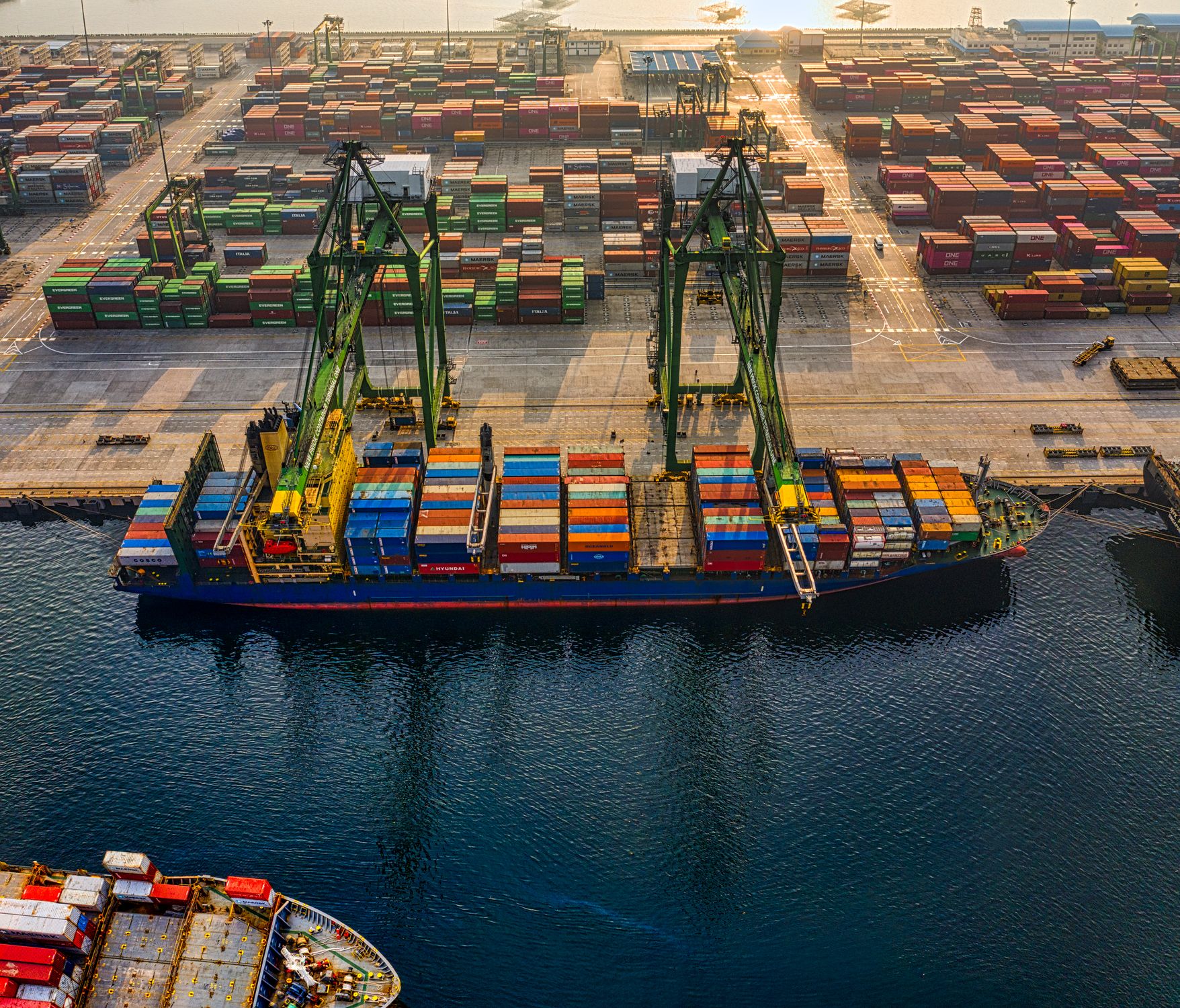
| Container yard blind spots (containers stack 2.9 m high, blocking ground-level views) | Ground cameras + security walks | Overhead AI surveillance catches open containers, tampered seals, unauthorized entry |
| Night and poor visibility (fog, darkness, rain) | Patrol effectiveness drops sharply after dark | Thermal imaging works in total darkness — no lighting needed |
| Vessel identity verification (AIS can be spoofed or turned off) | Visual name-match against logs | AIS integration + AI visual cross-check flags dark fleet vessels |
| Hazardous cargo / tank inspection (requiring close approach, high risk) | Manual climb-and-inspect | Thermal imaging remotely scans tank surfaces for leak/overheat signs |
Bottom line: The question isn't whether to put drones in ports — it's whether the system integrates with your existing VMS, AIS, and TOS. Done right, it's a force multiplier. Done poorly, it's just another monitor on the wall.
2. The market is accelerating (by the numbers)
Maritime security isn't a niche play. Fortune Business Insights data shows the global maritime security market at ~USD 34.8 billion in 2026, rising to USD 48.9 billion by 2034 (CAGR 4.3%). The Asia-Pacific region commands 57.3% of that share, and Middle East & African ports (Jebel Ali, Durban, Lagos) are the fastest-growing adoption corridors.
What's even more telling is the autonomous maritime security drone sub-segment: USD 78.49 million in 2025, projected to USD 132 million by 2032 (CAGR 7.9%, PW Consulting). This growth rate outpaces the broader market, which means automated drone systems are moving from pilot projects to full-scale deployment.
AI Tracking + Thermal Imaging: how the combo works in ports
① AIS + drone integration: locating suspicious vessels in seconds
The single biggest gap in traditional port security is response latency. You spot something wrong, but by the time a patrol boat or security officer reaches the location, 10–15 minutes have passed — and the evidence is gone.
AIS (Automatic Identification System) solves the positioning problem:
- All commercial vessels in port waters must broadcast AIS signals (vessel name, MMSI, position, speed)
- The drone dock system ingests AIS data feeds; anomalous signals trigger one-click dispatch — the drone autonomously flies to the target vessel
- On arrival, AI vision compares hull markings against the AIS-broadcast identity → flags "dark fleet" vessels (spoofed AIS, transponder off)
- Suspicious behavior (nighttime approach to restricted zones, undeclared cargo transfers) → auto-record + alert to command center
Dubai's Port Eye system runs on exactly this logic: 4K thermal + environmental sensors + AI analytics, reaching any target vessel within 3 minutes — 10× faster than traditional patrol boats.
② Thermal imaging: the port's night vision
What ports fear most isn't daytime — daytime is visible. It's the overnight window, especially 2:00–5:00 AM.
- Thermal imaging needs zero ambient light; human body heat at ~37°C is clearly detectable at 200–300 m range
- Container yard self-ignition: thermal can spot hotspots before smoke becomes visible (some coal/fertilizer stockpiles internally reach 80°C+)
- Oil/chemical storage tanks: thermal surface scanning detects anomalies, catching leaks before they spread
- Ship engines and deck equipment: remote overheat detection without personnel climbing
Operational flow: thermal spots the anomaly → AI classifies it (person vs. vehicle vs. equipment) → alert sent to security center → guard deploys with thermal handset for on-site confirmation.
③ AI tracking: from "spotting" to "holding"
Seeing the target isn't enough — you need to track and hold until help arrives:
- Thermal/acquisition trigger → AI auto-establishes tracking frame → drone holds orbit or follows
- Classification: person / vehicle / animal / vessel (AI categorization reduces false alarms)
- Anomalous behavior detection: loitering in restricted zones, fence climbing, container lock tampering
- Integration with existing VMS: alert pushed to security officers' handhelds with live video feed
How to integrate drones into your port's existing systems
This is where most projects live or die — drones cannot operate as an information silo.
Essential integrations
| Integration target | Purpose | Typical interface |
|---|---|---|
| AIS system | Vessel identity verification + one-click dispatch | REST API / NMEA data feed |
| VMS (Video Management System) | Drone video feed into existing security walls | ONVIF / RTSP |
| Port TOS (Terminal Operating System) | Vessel berthing schedule → pre-planned patrol routes | TOS API (e.g., Navis N4) |
| Perimeter alarm system | IR beam / vibration fiber trigger → autonomous launch | I/O hardwire or MQTT |
| Counter-drone system (if port has one) | Collaborative ops: detect intruder drone → countermeasure | CSDS / counter-UAS API |
Deployment architecture: Drone-in-a-Box
The standard deployment model for ports is Drone-in-a-Box (automated docking stations):
- Docks mount at elevated positions or key nodes across the terminal, IP65 rated, operating from -20°C to 55°C
- Drones launch, land, charge, and maintain themselves inside the dock — no on-site pilot required
- Scheduled missions (e.g., hourly patrol) + event-triggered launches (60–90 seconds after alarm)
- Multiple docks networked together for full-terminal coverage, feeding into a central command dashboard
Incheon Port's system uses this architecture: 12 fully autonomous patrols per day, replacing a 3-shift guard rotation, with launch response compressed from 5–15 minutes down to under 10 seconds.

Four mistakes that sink port security drone projects
Mistake 1: buying the drone but skipping the integration
The most common regret we hear: "the footage doesn't reach our existing monitoring screens." Integration work was never scoped, so the drone became another isolated monitor rather than a force multiplier.
Fix: require ONVIF/RTSP VMS integration and AIS API support in your RFP. Put integration scope in the contract — don't leave it as an "optional add-on."
Mistake 2: standard-grade docks failing in salt spray
Port environments are brutal on equipment: high salinity, strong winds, wide temperature swings. A standard industrial drone dock with insufficient IP rating (aim for IP55 minimum, IP65 preferred) will have cooling fans clogged with salt and circuit boards corroded within six months, sending failure rates through the roof.
Fix: choose docks designed for marine environments (Aerosophia, FlytBase, and similar port-specialist providers). Verify IP rating, salt-fog coating certification, and local lightning grounding requirements.
Mistake 3: BVLOS airspace approval stalling deployment
Operations inside port boundaries constitute BVLOS (Beyond Visual Line of Sight) flights — and civil aviation authorities regulate these differently across markets. The UAE (GCAA) has a relatively clear commercial BVLOS pathway; Nigeria (NCAA), Egypt (ECAA), and Saudi Arabia (GACA) have longer approval cycles.
Fix: - Research BVLOS requirements for your target market upfront (see our Saudi drone regulations guide and Nigeria import guide) - Some port authorities control their own airspace — negotiate directly with the port administration - Deploying docks within the port's fenced perimeter often simplifies approval
Mistake 4: too many false alarms and the team disables the system
AI recognition isn't 100% accurate. If a seagull triggers an alarm, or wind-blown container tarpaulins are classified as "intruder," the security team will gradually start ignoring alerts — and that's when real incidents go unreported.
Fix: - Run on-site AI model fine-tuning before commissioning (feed the system real port video to calibrate thresholds) - Set tiered alert levels ("observe" vs. "dispatch immediately") to reduce noise - Run a 2-week trial period before go-live, tuning parameters based on actual false-positive rates
One-line summary
Port security drones aren't about getting pretty footage — they're about collapsing 5–15 minute response times to 60–90 seconds and turning night blind spots into 24/7 automated coverage. Dubai Port Eye's 4 hours → 50 minutes and Incheon Port's 12 daily autonomous patrols are what this looks like in practice. Before you buy hardware, ask: are your AIS, VMS, and TOS interfaces ready?

We need your scenario
Whether you're planning a new port security system or plugging gaps in an existing one, send us a description of your site and we'll produce a configuration list and compliance assessment at no charge.
- Small-to-medium ports (1–5 million TEU/year) → 2–3 multi-rotor dock stations covering key shoreline
- Major hub ports → fixed-wing + multi-rotor hybrid deployment, full AIS/VMS integration
- Oil/hazardous cargo terminals → explosion-proof airframes + gas sensors + thermal payload
Message us on the inquiry page with "port security" in the subject line. A technical team responds within 24 hours. Consultation and compliance assessment are free.
FAQ: Frequently Asked Questions
Does port security drone operations require BVLOS airspace approval?
Yes. Port areas are controlled airspace, and BVLOS (Beyond Visual Line of Sight) drone operations require approval from the local civil aviation authority. The UAE (GCAA) has a relatively clear process (~3–4 weeks), while Saudi Arabia (GACA), Nigeria (NCAA), and Egypt (ECAA) have longer review cycles (4–8 weeks). We recommend asking your supplier to assist with the approval documentation — see our Saudi drone regulations guide and Nigeria import guide for specific country procedures.
Do I need both thermal and visible-light cameras?
Yes — they're complementary, not interchangeable. Thermal handles night operations and smoke/fog penetration; visible-light handles daytime high-resolution identification (container numbers, license plates, hull markings). A dual-sensor gimbal (thermal + zoom EO) is the standard configuration for port scenarios. Single-sensor systems only work in limited conditions.
Can the drone system integrate with our existing port security platform?
Most reputable vendors support standard protocols (ONVIF, RTSP, REST API) and can feed into existing VMS and port management systems. However, this must be explicitly scoped in your procurement — don't assume it's included. Premium platforms like FlytBase and Aerosophia offer pre-integrated solutions that plug in out of the box.
What drone type is best for port security?
Fixed-wing platforms excel at wide-area patrols (60–90 minute flights covering 10 km+ of shoreline). Multi-rotor platforms excel at precision work (hover-and-inspect, thermal scanning of specific assets). Drone-in-a-Box systems typically pair with multi-rotors for precise landing; fixed-wing requires a dedicated runway. Small-to-medium ports usually need multi-rotor docks only; major hubs (Jebel Ali, Singapore) often deploy hybrid fleets.
How is port security different from border security drones?
The core difference is integration complexity. Port security requires connecting to AIS, VMS, TOS, and perimeter alarm systems — multiple enterprise data streams. Border security focuses more on long-range mobile patrols and coordination with border command centers. The underlying technology (AI recognition, thermal, docks) is similar, but the system integration requirements are different. See our border security drone guide for the land-side perspective.
How long does deployment typically take?
Standard timeline: 2–4 weeks for hardware installation + network setup + AI model on-site fine-tuning → another 2 weeks of trial operation (recording false-positive rates, adjusting thresholds) → go-live. Total: 6–8 weeks. If AIS/VMS integration is complex, expect 10–12 weeks. Dubai's Port Eye system took roughly 5 months from project kickoff to operational.
Disclaimer: This article is based on publicly available information and field experience. Specific regulations and technical specifications should be verified against official sources and supplier current documentation.